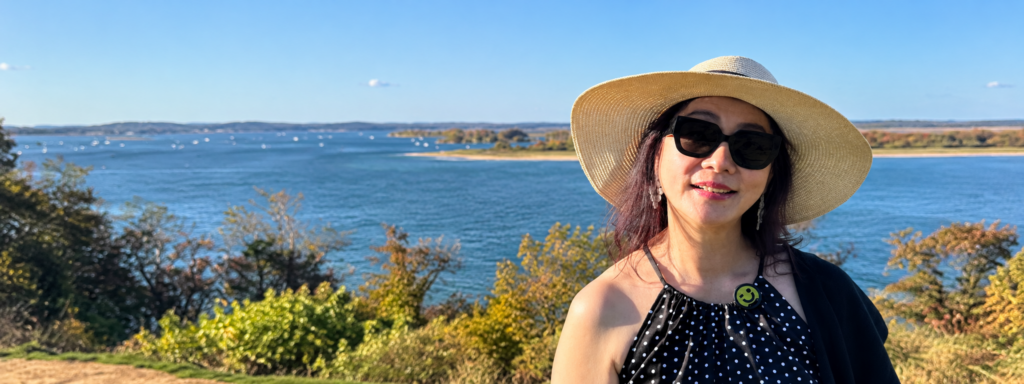
By Hannah McMillan
When Suvaluck Kongsomboonvech reflects on her breast cancer journey, she remembers more than the diagnosis, surgery, or radiation. She remembers the friends who showed up with meals, her children who stood beside her, and the faith that helped her navigate life’s uncertainties. For Suvaluck, a Thai-Chinese immigrant from Bangkok, Thailand, facing breast cancer was not simply about enduring treatment. It was also about learning to accept help and discovering that strength does not always mean facing life’s challenges alone.
A Life Shaped by Love and Loss
Born and raised in Bangkok, Suvaluck was the youngest of six siblings in a family of Chinese immigrants. Her parents spoke Teochew, a Chinese language that connected the family to their cultural heritage. She earned a bachelor’s degree in business administration from Ramkhamhaeng University and spent 18 years working in finance at Thai Airways. During this time, she met her husband, and together they raised three sons. In 1999, her husband and children immigrated to the United States, and Suvaluck joined them in California two years later.
Among the memories Suvaluck treasures most is a seemingly ordinary detail from the day she met her husband: a pair of Hello Kitty slippers. Even years later, he could recall exactly what she had been wearing when they first met. It was a small, playful memory that reflected the affection and attentiveness that defined their relationship.
Those moments became especially meaningful when the family faced an unimaginable loss. In 2020, Suvaluck’s husband was diagnosed with lung cancer and passed away shortly afterward. His illness unfolded amid the uncertainty of the COVID-19 pandemic, making the time their family spent together especially precious.
Suvaluck would also face a cancer diagnosis of her own. Following a routine annual mammogram, she learned that she had breast cancer and subsequently underwent a lumpectomy and radiation therapy. Navigating her diagnosis and treatment, alongside the grief of losing her husband, brought profound challenges. Throughout these experiences, however, she found comfort in the relationships and community she had built over the years.
Beyond Awareness: Breast Cancer and AANHPI Health
Suvaluck’s experience comes amid concerning trends in breast cancer incidence among Asian American, Native Hawaiian, and Pacific Islander (AANHPI) women. A 2026 study published in JAMA Network Open found that invasive breast cancer incidence among Asian American women increased by an average of 2.34% annually between 2012 and 2022. The same study noted that incidence rates rose by an estimated 4.57% annually among Chinese women between 2017 and 2022 and 4.30% annually among Vietnamese women between 2016 and 2022. These findings underscore the importance of disaggregated health data and culturally responsive approaches to breast cancer education and screening.
Early detection remains an important component of breast cancer care. The U.S. Preventive Services Task Force recommends screening mammograms every two years for women ages 40 to 74 at average risk. Individual screening needs may differ based on personal and family history and other risk factors. Suvaluck’s diagnosis following a routine mammogram highlights the value of access to preventive care and timely follow-up.
Finding Strength in Community
Throughout her husband’s illness and her own breast cancer journey, faith became an important source of comfort for Suvaluck. Shortly after immigrating to the United States, she converted from Buddhism to The Church of Jesus Christ of Latter-day Saints after a neighbor invited her to attend a service. Over time, her congregation became more than a place of worship. It became a community of friends and neighbors who offered practical and emotional support during some of her family’s most difficult moments.
When her husband was ill, church members brought meals and offered assistance. That same generosity continued during Suvaluck’s treatment and recovery. Their kindness reminded her that she did not have to carry every burden herself and that accepting support was not a sign of weakness.
Looking back, Suvaluck wishes she had understood sooner that it was okay to feel afraid and express those fears. During treatment and recovery, she came to recognize that she did not always have to be strong and that accepting help could be an important part of healing.
Her children also helped her find moments of lightness during difficult times. Their laughter and playful teasing, especially about her cooking, offered welcome reminders that joy could still be found amid uncertainty. Her husband had always been the family’s chef, and her sons’ good-natured jokes about her culinary skills became a source of humor and connection.
These everyday moments helped Suvaluck develop a deeper appreciation for life’s simple pleasures. Morning walks, the warmth of the sun, and the beauty of a sunset took on new meaning. Rather than focusing on everything beyond her control, she learned to embrace the present and find gratitude in the people and experiences surrounding her.
Today, Suvaluck continues to draw strength from her family, her faith, and the community that supported her through illness and loss. Her story reminds us that resilience is not always about standing tall or putting on a brave face. Sometimes, it is about allowing others to hold us up.
Breast Cancer Awareness: Know Your Risk, Know Your Options
Breast cancer awareness matters year-round. Understanding individual risk factors, discussing screening options with healthcare providers, and having access to culturally responsive health information can help individuals make informed decisions about their breast health.