
Community-Engaged Research
Research is stronger when communities help shape it.
Asian American, Native Hawaiian, and Pacific Islander (AANHPI) communities remain underrepresented in health research, leaving important gaps in our understanding of their health experiences, needs, and priorities. Language barriers, limited access to research opportunities, mistrust, and the aggregation of diverse populations into broad racial categories can deepen these inequities.
At Asian Women for Health (AWFH), we believe community-engaged research offers a path forward. By bringing together community knowledge, lived experience, and research expertise, we can build more equitable approaches to understanding health—and ensure communities have a meaningful role in shaping the research that affects them.
Our Research Principles
Our community-engaged research approach is guided by principles that center equity, shared power, and community expertise throughout the research process.
Representation matters. But equity requires more than participation.
Equitable research is not simply about who participates. It is also about whose knowledge is valued, who has a voice in decisions, and who benefits from what we learn.
Community-engaged research creates space for communities to contribute their expertise throughout the research process. This can lead to more relevant questions, culturally and linguistically responsive approaches, and knowledge that better reflects—and can be used by—the communities research is intended to serve.
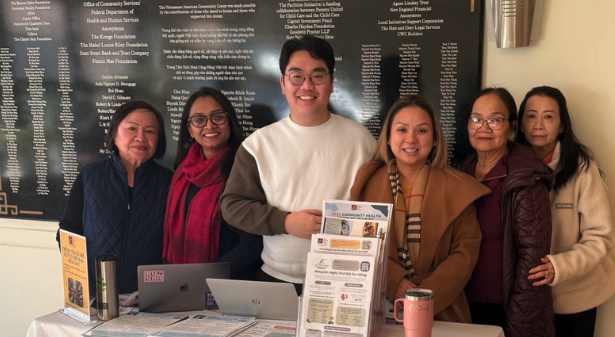
The AWFH team with Dorchester community members during a Community Listening Session exploring the impact of Carney Hospital’s closure on the community.
We’re designing for the future.
Community-engaged research gives us an opportunity not only to improve how research is done, but to imagine what it could become.
At AWFH, we believe innovation starts with curiosity: asking better questions, testing new approaches, and being willing to rethink systems and practices that no longer serve all of our communities. By connecting community knowledge with research, technology, and new ideas, we can explore solutions that are more responsive to how people live, connect, and access care.
The future of science, medicine, research, and policy – is something we can help shape together.