
 Dear Friends,
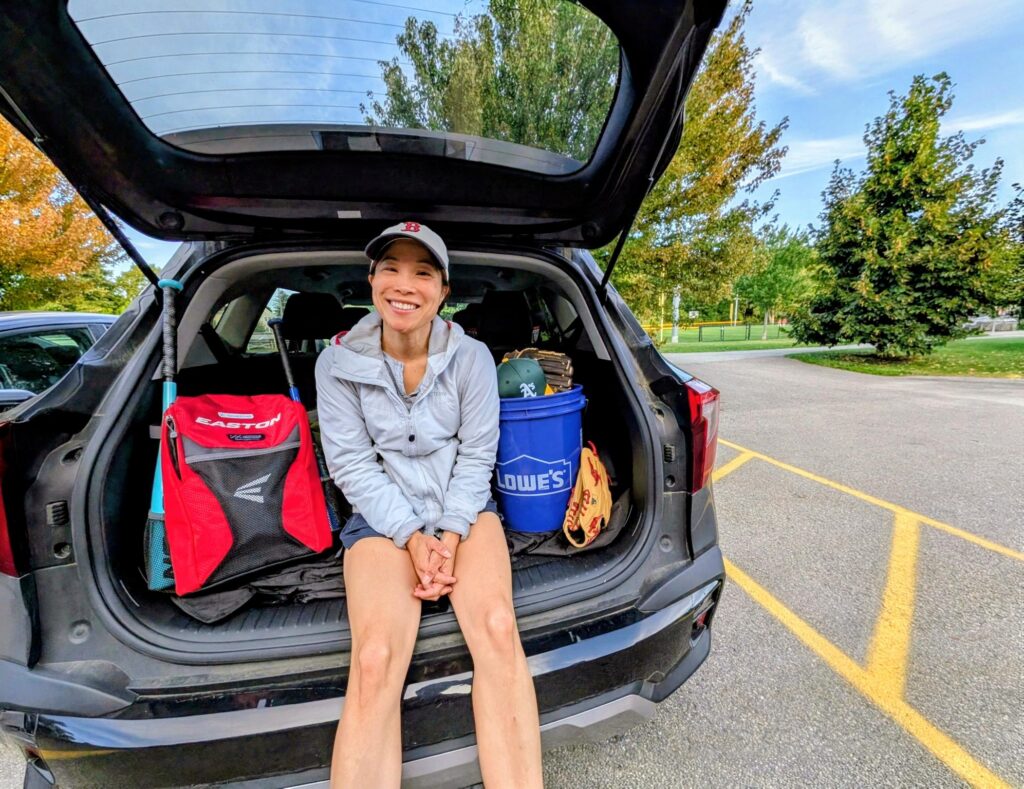
On any given Sunday this fall, you can probably find me standing on a Little League baseball field with a clipboard in one hand, a water bottle tucked under my arm, and a group of first grade boys who may or may not remember which direction to run after they hit the ball.
There is usually a missing glove to track down, a helmet that needs adjusting, and at least one kid far more interested in building sand castles in the infield, than whatever else is happening – while I do my best to keep track of who has batted, who is playing where, and, most importantly, whether everyone is having fun.
In August, I made the decision to coach my son’s fall baseball team, and truthfully – I love it. There is something wonderfully grounding about spending a Sunday afternoon on a ball field, watching a group of six and seven year olds learn how to be teammates, encouraging them when something is hard, and celebrating the small victories that seem enormous when you are that age.
It is also a funny contrast to the rest of my week.
I’m not yet 40, and at this particular moment in my life, I’m raising a young child while leading a non-profit and working toward finishing my doctorate. I’m a wife, a daughter, a sister, and a friend, with people I want to show up for, work that matters deeply to me, and a family and community I love.
None of those things feels incidental to the life I want – and in many ways, they are the life I want.
And yet, somewhere between the baseball field and the office, between school drop-off and grant deadlines, between caring for a child who still needs me in very tangible ways and beginning to think about what the people who raised me may need as they grow older, I’ve found myself thinking about just how much women are expected to hold all at once.
There is a particular convergence that seems to happen for many of us in these middle years. We may be raising children just as our parents begin to need more from us; reaching new levels of responsibility in our careers while carrying much of the invisible work that keeps families and households moving; trying to nurture marriages, partnerships, friendships, and communities while also being reminded that we should exercise more, sleep more, manage our stress, keep up with screenings, eat well, and somehow make time for ourselves.
And while all of that is happening, our own bodies are changing, too.
For many women, conversations about perimenopause and menopause begin during precisely the years when life seems to leave the least room for them. Questions about bone health and memory loss emerge alongside questions about an aging parent’s health. We may be trying to support our children’s mental health while managing our own. And somewhere in the midst of all of this, many of us are also doing the quieter work of examining what we inherited – patterns of silence, sacrifice, stigma, or trauma – and deciding what we want to carry forward and what we hope to leave behind. We are caring across generations while, in many ways, trying to change what care can look like for the generations that come after us.
Of course, none of these experiences happen in isolation. Women’s health happens in the middle of everything else.
Of course, none of these experiences happen in isolation. Women’s health happens in the middle of everything else.
Yet, we often talk about health as though it occupies a separate lane, as though caring for ourselves is primarily a matter of making better choices, developing better habits, or somehow finding more time.
The problem, of course, is that there is no hidden reserve of hours waiting to be discovered.
The challenge is not that any one of these expectations is unreasonable. I want to be present for my son. I care deeply about my work. I want to be a good partner, daughter, sister, and friend, and I want to contribute meaningfully to the community around me. The tension comes from the fact that these things do not arrive one at a time, neatly waiting for the previous responsibility to be completed.
They arrive together.
That reality matters when we think about women’s health, because we cannot meaningfully understand a woman’s health without understanding the life surrounding her – the people she cares for, the responsibilities she holds, the resources available to her, the culture and community that have shaped her, and whether the systems around her make caring for herself easier or harder.
For Asian American, Native Hawaiian, and Pacific Islander (AANHPI) women, there are additional layers to that story. Our communities have historically been underrepresented in health research, while broad categories like “Asian American” can flatten enormous differences in ethnicity, language, culture, migration history, socioeconomic circumstances, and generation. When those differences disappear, so too can important parts of our health experiences.
But there is another kind of gap I think about, one that feels particularly personal to me as a daughter and now a mother myself: the gap between what generations of women have so beautifully passed down to us and the health knowledge that, for many reasons, did not always make the journey with it.
We inherit so much from the women who came before us – traditions and stories, recipes and rituals, expectations and ways of showing love, including, in many families, a remarkable ability to notice what everyone else needs and quietly make sure it gets done. What we do not always inherit is the same language for understanding and caring for ourselves.
There are so many conversations that some of us never had with our mothers or grandmothers – about what happens to our bodies as we age, about mental health, sexuality, memory, or the changes we might one day experience ourselves. Some things were considered too private to name. Others were shaped by stigma, culture, or language. And sometimes, the women who came before us simply could not tell us what no one had ever had the opportunity to tell them.
I don’t see that as a failure of the generations before us; if anything, I see it as an opportunity – and perhaps a responsibility – for ours.
I don’t see that as a failure of the generations before us; if anything, I see it as an opportunity – and perhaps a responsibility – for ours.
What would it look like if caring for ourselves became part of what we passed down, too? Perhaps our daughters could enter adulthood understanding more about their bodies than we did. Perhaps our sons could grow up seeing caregiving not as something women quietly absorb, but as something families and communities share. Perhaps conversations about mental health, perimenopause, menopause, aging, memory, and caregiving could begin long before a moment of crisis forces us to have them.
These are the kinds of questions increasingly shaping how I think about our work at Asian Women for Health.
We are creating spaces where young people can talk honestly about mental health and belonging, while opening up conversations about women’s health across the lifespan that many of us may not have grown up having. And through community-engaged research like BRAIN-V, we are listening to Vietnamese older adults, caregivers, and families to better understand how our communities experience aging, brain health, and memory.
On paper, these may look like very different areas of work. But I have come to see them as part of the same story: how we give people the knowledge, language, support, and agency to care for themselves and one another across a lifetime – and how, in doing so, we might leave the generations that come after us with something different from what we inherited.
Women’s health doesn’t begin or end at any particular age, and neither should the support we receive to care for it.
I’m not convinced that “balance” is the right goal, because balance suggests there is some perfect arrangement in which every part of our lives receives exactly what it needs and nothing ever spills over. I certainly haven’t found it.
What I do believe is that women deserve good information, supportive communities, culturally responsive care, and systems that recognize the realities of their lives. And perhaps we also need to become a little more comfortable including ourselves among the people whose well-being we feel responsible for protecting.
Which brings me back to Sunday.
On any given Sunday, you’ll still find me on that baseball field, probably carrying too many things, checking the time because there is always something that comes next, and reminding a six year old that his glove is significantly more useful when it is actually on his hand.
By Monday morning, I’ll be back at the office. There will be meetings to lead, decisions to make, a dissertation waiting for my attention, a family calendar to manage, people I love who need something from me – and, somewhere among all of those things, a life of my own that deserves tending, too.
I wouldn’t trade the fullness of this life. But I also don’t believe women should have to disappear inside the lives they love.
Perhaps that is what I keep coming back to when I think about women’s health across the lifespan: not the impossible pursuit of perfect balance, but the possibility of building families, communities, workplaces, and systems in which caring for others and caring for ourselves are not treated as competing choices. There has to be room for both.
As we look ahead to another season at Asian Women for Health, that is the kind of future I want us to keep building, together.
With deepest gratitude,
Colleen M. Nguyen